Al Khamsa: The Strains
Bedouin legends tell the story of a group of mares who were known as the Al Khamsa–the five. These were the five favorite mares of Muhammed. According to legend, a tribe of Bedouin, after a long journey across the desert, released their mares to run to a watering hole to drink. As a test of loyalty, Muhammed blew his horn to call the mares back to him. The five which returned became the Al Khamsa, the foundation mares of the five strains.
Bedouins highly prized pure-in-strain horses. The five basic strains include Kuheilan, Saklawi, Abeyyan, Hamdani, and Hadban. (You will find varying ways of spelling these, such as Koheylan, Koheilan, Kehilan, Seglawi, Seqlawi, Obeyan, Obeyyan, Abeyan, etc. because translation of Arabic into English is largely phonetic in nature. I have used here the spellings which predominate this site, in order to save further confusion.) Other strains, considered less “choice” by the Bedouins, also developed over time, including the Maneghi, Jilfan, Shuwayman, and Dahman. There are also substrains within each strain.
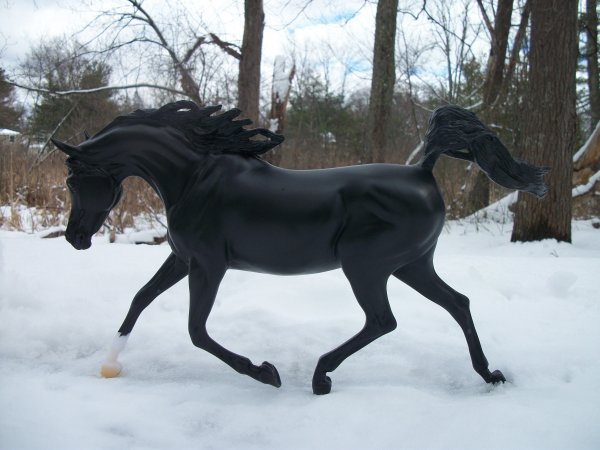
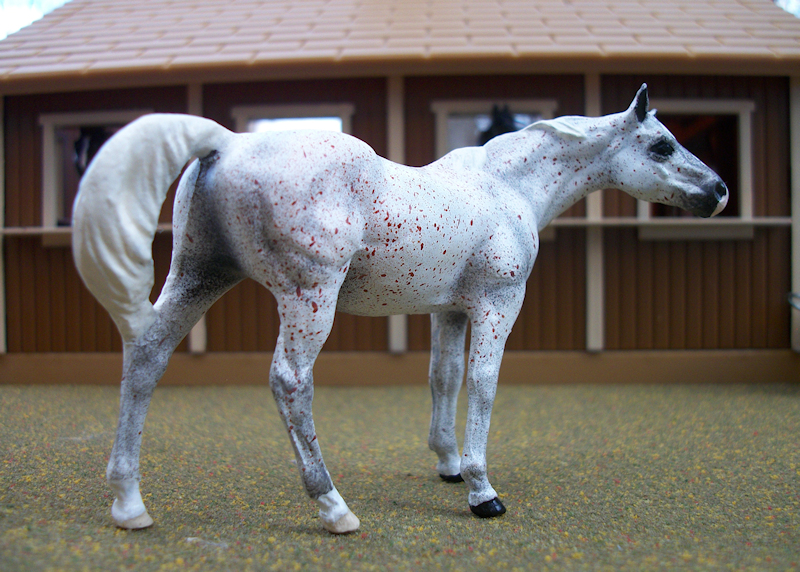
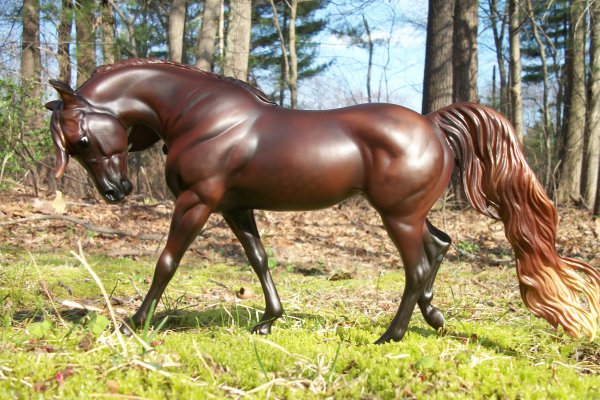
Each strain, when bred pure, developed traits that could be easily recognized and identified. Kuheilan horses are noted for their depth of chest, masculine power, and size; their heads are short, with pronounced jibbah and jowls, and they are most commonly grey and chestnut. Saklawi are known for refinement and almost feminine elegance; they are typically fine-boned, with longer faces and necks than the Kuheilan, and are generally rather small (14.2 hands) and bay. Abeyyan are similar to Saklawi, in that they are very refined in their look, but they often have a longer back than the typical Arabian, and tended to be quite small (seldom above 14.2 hands); they were usually grey, and carried more white markings than the other strains. Hamdani horses are athletic, if somewhat masculine, with a large-boned build; they tend to lack an extreme Jibbah; they are one of the largest of the strains, generally standing over 15.2 hands, and the most common colors are grey and bay. Hadban (aka Hadban Enzahi) tend to be a smaller version of the Hamdani, sharing several traits, including the big bones and muscular build; they are also known for having an extremely gentle nature, and their primary colors are bay or brown, with very few white markings. Dahman (also known as Dahman Shahwan) represent a blend of Saklawi in elegance and Kuheilan in muscularity and carriage, though they tend to be taller than either of these two strains.
Ancestral Elements
Egypt I: Thousands of Arabian horses were imported into Egypt prior to about 1900; of those, the few which managed to breed on and become Al Khamsa Foundation Horses became those which we now recognize as “Egypt I”. This designation includes the horses of Abbas Pasha and Ali Pasha Sherif as well as a few other Egyptian breeders, who imported Arabians into Egypt between 1840 and 1900. These horses are the source of all modern Egyptian and part-Egyptian bloodlines. This element will always be found in combination with at least one other Ancestral Element, most usually Blunt.
Inshass: The Inshass Stud was maintained as the private venture of former Egyptian kings Fuad and Faruq (Farouk), who ruled (combined) between 1917 and 1952. Most of their breeding stock came from established Egypt I and Egypt II bloodlines, but they also acquired nine additional Foundation Horses. These bloodlines are always found in combination with Egypt I and Blunt.
Blunt: Between 1877 and 1881, Lady Anne and Wilfrid Blunt made three trips into the desert to acquire Arabian horses. After, up until around 1913, they subsequently employed agents and/or aqayls to acquire more Foundation Horses and also to purchase Egypt I horses. In modern horses, the Blunt bloodlines are found always in combination with the Egypt I element. Horses known as “Straight Egyptian” always trace to both Egypt I and Blunt. Most also trace to Inshass and Egypt II.
Egypt II: In 1914, the Royal Agricultural Society (RAS) Arabian breeding program was established in Egypt. Originally based on available bloodlines (Egypt I; Inshass), five additional Foundation Horses were later procured by private individuals.
Sa’ud: Horses exported to North America by the Sa’ud family, long noted for their breeding of Arabian horses, are designated as a distinct element at Al Khamsa.